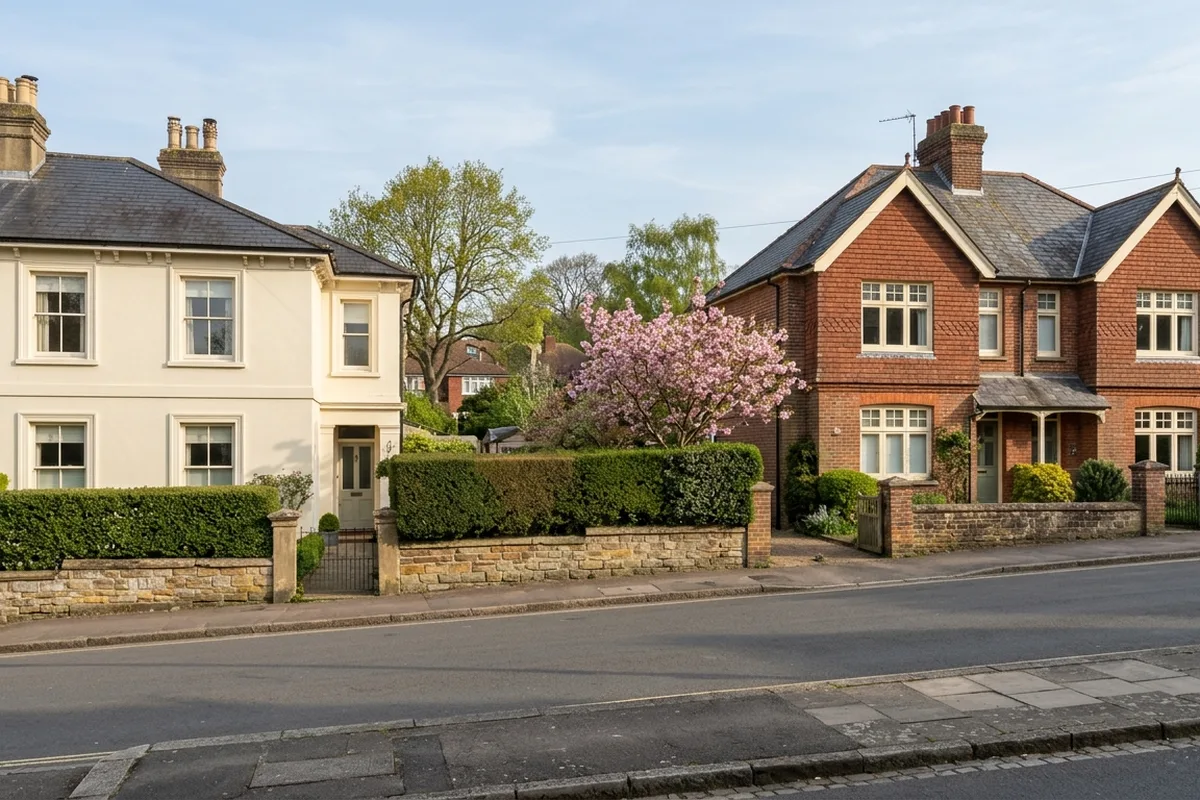
This guide goes through the town's main building periods, what the windows were like in each, and what to fit now. If you came here from the picker, find your house's age below and follow the link.
The spa town: 1680s to 1800
Building began in earnest in the 1680s, with shops along the Pantiles and Mount Sion laid out in small plots. The Church of King Charles the Martyr dates from 1684. Houses from this period that survive are almost all listed. The listing for 17 Mount Sion, an eighteenth-century house, records a stucco ground floor, tile-hung upper floors and sash windows with their glazing bars intact on the main front. These houses need listed building consent, and timber made to the existing pattern. See permission.
Regency and early Victorian: 1820s to 1850s
Decimus Burton laid out Calverley Park from 1828, with 24 villas of Tunbridge Wells stone, all now Grade II*. Camden Park followed from about 1853, with stucco Italianate houses whose sashes, in one listed example, have no glazing bars. St James was laid out in the same decade. For unlisted houses of this age, a sliding sash in the existing pattern is the starting point.
The railway town: 1845 to 1890s
The branch line from Tonbridge opened in 1845 and the town kept growing. St James was largely built by 1871. In Southborough, the villas on Pennington Road and Park Road date mostly from the 1860s, and the Holden Estate was laid out for 165 houses from 1879. Sashes at the front, casements at the back and bays on many terraces. See period homes.
Edwardian red brick: 1890s to 1914
Madeira Park was laid out in 1893 and Warwick Park in 1896. Red brick, clay tiles, tile-hung gables and painted timber casements with small panes in the upper lights. See Edwardian casements.
Between the wars and after: 1920s to 1970s
Warwick Park was still being filled in between the wars. After the Second World War the town built large estates at Sherwood and Ramslye, and Pembury's private estates followed in the second half of the century. Plain casements, so the choice is about warmth and upkeep. See later houses.
Since about 1980
Infill on the grounds of big villas, newer estates and many rear extensions. Slim aluminium often suits these, along with new garden doors.